Everything that's wrong. In the order to fix it.
No page meter. No credit counter. Nothing to check before you run an audit.
Point Docket at any site. 99 checks across technical SEO, copy, conversion, brand, AI search visibility and campaign tracking — then one ranked plan with the markup to paste. Not four tools. One download.
Or four payments of $87.25 with Klarna or Afterpay, two weeks apart — the last one six weeks after the first, at no extra cost from us. Then it stops, and it is yours.
30 days, no conditions, no questions asked — refund policy
macOS 12+ · Apple Silicon · 22.0 MB · notarised by Apple · no account · one licence, all your sites · nothing to cancel
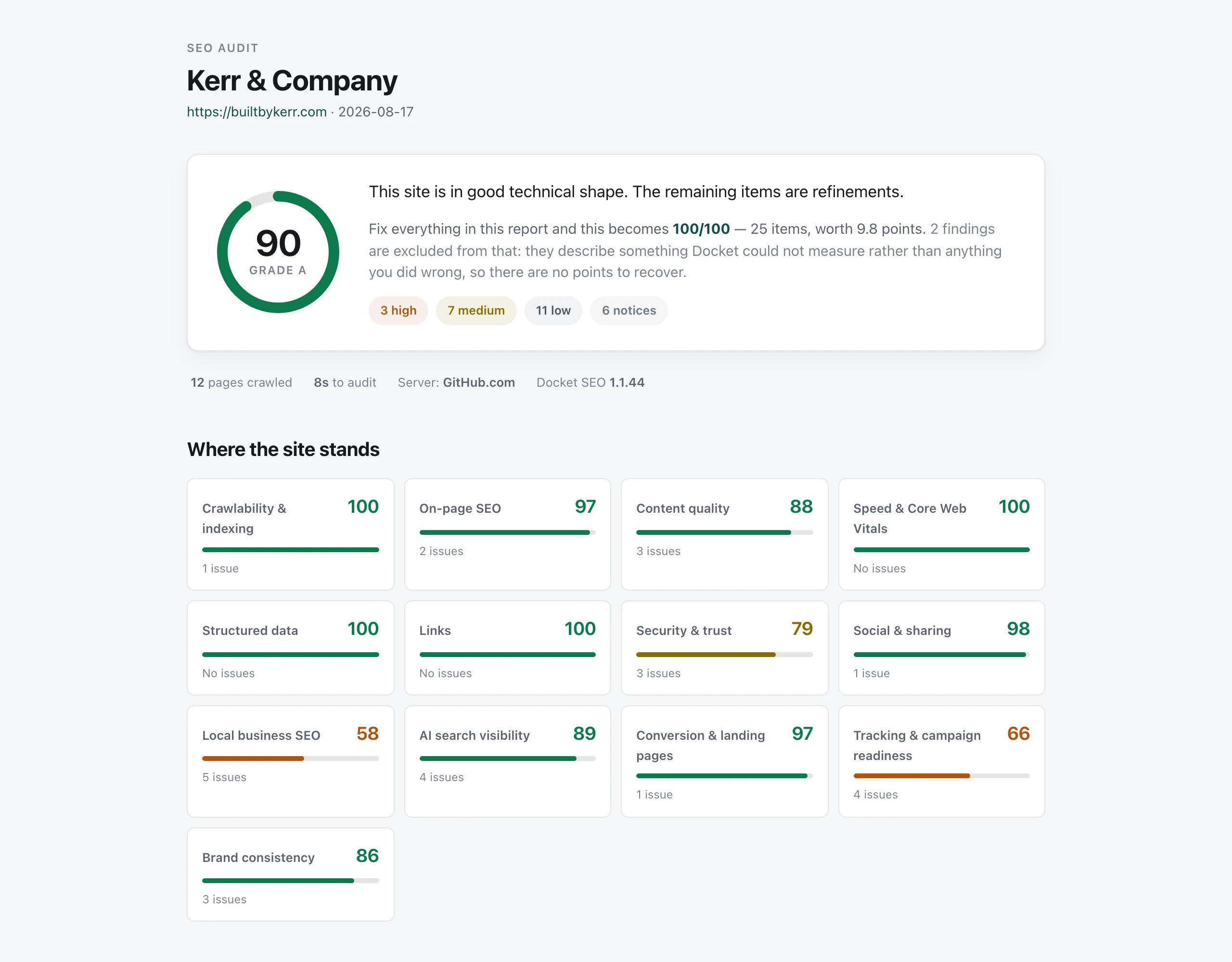
This is the actual report.
Run against our own site.
Not a mockup and not a marketing render — the file Docket writes, opened in a browser. We pointed it at our own agency site rather than a competitor's, because publishing someone else's audit without asking is not ours to do, and because this is the one report we cannot quietly curate.
Most tools hand you a list.
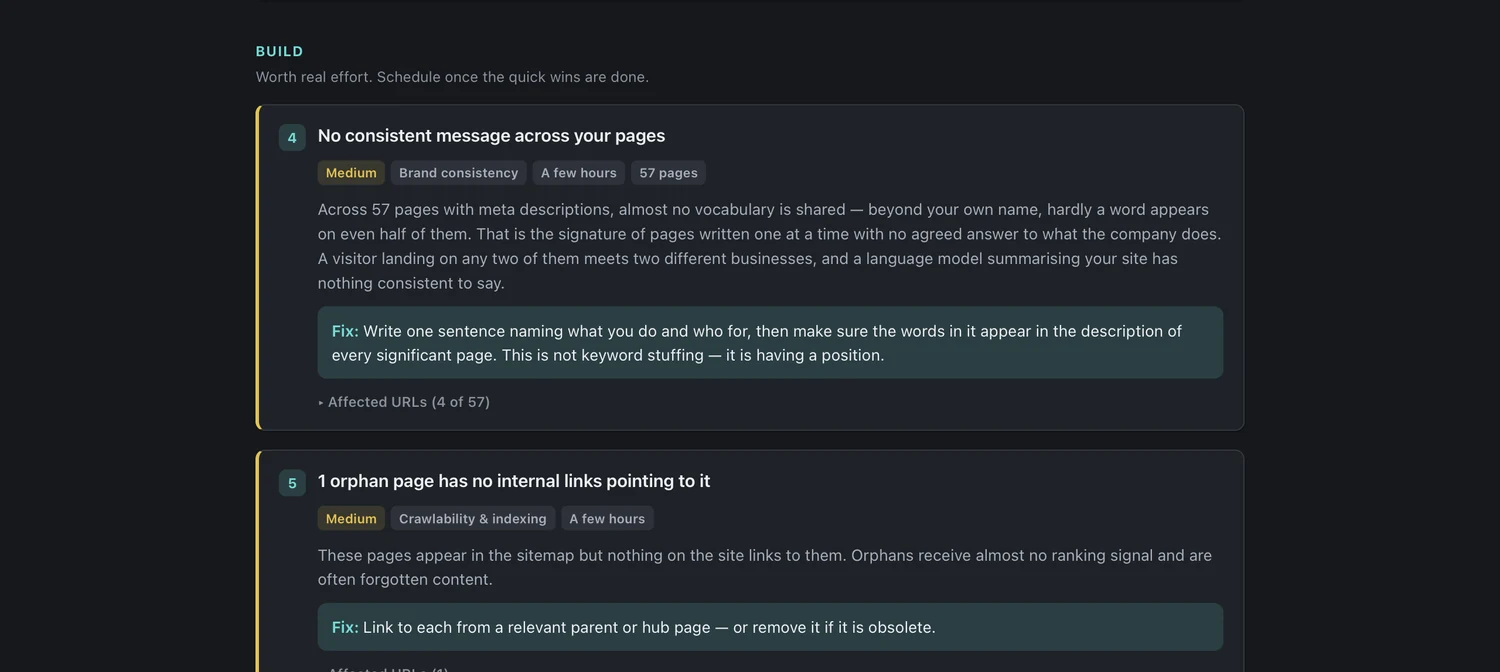
This one hands you an order.
Semrush publishes 140+ checkpoints. Ahrefs lists 170+. Neither tells you what to do first — and ordering is the hard part. Sitebulb is the exception worth naming: it prioritises too.
- — 412 pages have a short title
- — 38 pages missing meta description
- — 1 page set to noindex
- — 96 images without alt text
- — 12 redirect chains
- — …and 160 more rows
Ranked by what each one costs you, not by category.
Four things a crawler will not tell you.
Technical SEO is table stakes, and it is most of what a crawler is built to return. These four are where the money actually leaks. None of them appears in the feature list Screaming Frog or Sitebulb publishes, and elsewhere each is a separate subscription — checked against their own documentation, 13 August 2026.
AI search visibility
Every AI crawler in one pass, because GPTBot trains models and
OAI-SearchBot builds the index ChatGPT answers from — blocking them is not
the same decision. A crawler can answer this one a user-agent at a time: Screaming Frog
lets you switch agent and follow that agent's robots.txt directives. What it
reads is the file. Docket also asks the server, as each bot, and tells you when the two
disagree — a CDN rule blocking GPTBot is invisible in a
robots.txt that permits it.
Conversion & landing pages
Calls to action, the above-the-fold promise, form friction, social proof, whether the price is findable, and whether the headline matches what the search result promised.
Brand consistency
Whether your company name is spelled the same way in your title tags, your schema, your og:site_name and your logo alt text — because that is where a knowledge panel and an AI citation get it from. Plus typeface and palette sprawl, and whether every page makes the same promise or a different one.
Local business SEO
NAP consistency, LocalBusiness schema and its subtypes, opening hours, geo signals, review markup — and it knows a software company with an office is not a local business.
Can an AI answer even reach you?
A crawler reads your robots.txt and believes it. Docket asks
your server — as OAI-SearchBot, as ClaudeBot, as
PerplexityBot — and compares the answer to what the file promises.
The file says yes, the server says no
A bot-protection rule at your CDN blocks anything not on its known-good list, and AI
crawlers are newer than most of those lists. Nothing in your robots.txt shows
it. Docket makes the request and reports the disagreement.
It knows what you meant
Blocking GPTBot on purpose is a decision, not a defect — it trains
models. OAI-SearchBot builds the index ChatGPT answers from, which is a
different decision. Docket only reports the crawlers your own file permits and your server
refuses anyway.
10 checks, not one
Whether your content survives without JavaScript, whether your claims are specific enough to quote, whether your entity is defined, whether your dates are machine-readable, and one control that cannot be measured from outside — which Docket says plainly rather than guessing.
Is the page actually in there?
Being indexed is not a property of your HTML, so no crawler can read it off your page. Docket asks Google, Bing and Brave directly, with your own credentials, and records what you announced through IndexNow — then says which of those answered about the page and which answered about the site.
Per page, where per page exists
Google answers for a single URL against a property you have verified, so that column is real. Bing answers for the whole site and says so, because its per-URL call throttles long before a real site finishes. Two different questions, never averaged into one score.
It will not invent an absence
Brave can only be enumerated to a fixed depth. Past it, “not in the results” and “past what anyone could read” are the same observation, so Docket reports blindness rather than telling you a page is missing when nobody looked.
Announcing is not indexing
IndexNow records that you told the search engines a URL changed. That is a real action and a useful one, and it is still your outbox rather than anyone's index — so it is labelled a submission and never counted toward whether you are indexed.
We measured who's blocking AI search.
30% of the 98 major sites we measured block at least one AI search crawler. Among those blocking any AI crawler, roughly three quarters also blocked the ones that decide whether they appear in ChatGPT — almost certainly without meaning to.
Share of sites in each category blocking at least one AI search crawler. 98 sites with a robots.txt, measured 2026-08-06 with Docket's own parser. The script and the site list ship with the dataset — re-run it and check.
What you actually get.
A sequence, not a pile
Every finding ranked by impact against effort, in four phases. There is always a defensible first task — and every finding carries its evidence: the page it is on, the exact value found there, and the fix.
Client-ready PDF
Designed to send, not rebuild. Score, scorecard, ranked plan, paste-ready markup — and a scope page saying exactly what was and was not measured.
Scheduled monitoring
Re-audits on a cadence and tells you what changed. Regressions first — a site that was clean and broke is the thing you need to know. It runs while Docket is open: the schedule is a thread inside the app, not a background daemon, so quitting it stops the clock.
Go on the offensive
Against a rival with years and links you cannot match, Docket finds where none of that helps them — crawlers they have blocked, rich results they cannot win, searches neither of you answers. It reads their domain authority from Common Crawl so the size of the gap is a number, not a guess. See what it finds.
Nothing is uploaded
No account and no telemetry. Activating your licence is the one thing that
contacts us, and after that it is checked about once a day. The crawl only ever touches the site you
are auditing; five optional checks also fetch data Docket cannot produce alone,
and --offline turns all five off.
A CLI, including docket attack
docket audit exits non-zero on a critical issue — a noindexed homepage, a
5xx — so CI can fail the build before it ships. --fail-on high lowers the bar.
docket attack ranks a competitor's weak points by how winnable they are.
$349. Once.
Or four payments of $87.25 with Klarna or Afterpay, two weeks apart — the last one six weeks after the first, at no extra cost from us. Then it stops, and it is yours.
Every tool below is a subscription. Docket is a one-time purchase, and the audit runs on your Mac, so there are no crawl credits to ration.
| Tool | Price | Runs | Output |
|---|---|---|---|
| Docket | $349 once | Your Mac | Ranked fix plan |
| Ahrefs Site Audit | $129–$449/mo, or $1,290–$4,490/yr paid annually | Cloud, metered | 170+ issues |
| Semrush Site Audit | $139–$549/mo | Cloud, metered | 140+ checkpoints |
| Sitebulb | $18–$42/mo ($180–$425/yr read from their annual pricing page) | Local + cloud | Visual issue report |
| Screaming Frog | $279/yr USD | Your machine | Raw crawl data |
Checked against the vendor's own pricing page: Ahrefs Site Audit checked 2026-09-09 (source); CrawlRaven checked 2026-09-16 (source); Google Lighthouse checked 2026-08-10 (source); JetOctopus checked 2026-09-16 (source); Otterly.AI checked 2026-08-10 (source); Profound checked 2026-09-16 (source); SE Ranking checked 2026-09-08 (source); SEOptimer checked 2026-09-16 (source); Screaming Frog checked 2026-09-16 (source); Scrutiny checked 2026-08-15 (source); Semrush Site Audit checked 2026-09-09 (source); Sitebulb checked 2026-09-08 (source); Sitechecker checked 2026-09-16 (source); Ubersuggest checked 2026-08-10 (source); crawler.sh checked 2026-09-16 (source). Prices change; check before you buy, and tell us if one here is wrong.
Or you could pay someone to do it.
That table is the wrong comparison for most people. They are not choosing between two crawlers — they are choosing between buying a tool and hiring somebody, and those are different orders of magnitude.
| What you could buy | Price | For that you get |
|---|---|---|
| Docket | $349 once | Unlimited audits, on your Mac |
| WebFX, published rate | $8,600/month | Up to 70 pages reviewed; up to 2.5 hours of implementation support |
| Agency retainer, survey average | $3,209/month | Average monthly retainer across all agency respondents |
| One-off project, most common band | $2,501+ | Most common one-off project fee band ($2,501–$5,000) |
One month at the published agency rate is 24 Docket licences. The bottom of the most common one-off project band is 7. Docket is bought once and run as often as you like.
And what you get back is the thing you were paying for: every finding says how bad it is, how long the fix takes and the exact change to make — naming the pages, where it is a page-level problem rather than a site-wide one. That is why it pays for itself the first time you act on one report, instead of the fifth month of a retainer.
Where these come from: WebFX’s own published price, read 2026-09-08; Ahrefs survey of 439 providers, published 2024-08-15. Docket is not an agency and does not do the work an agency does — it produces the audit, not the fixes.
What Docket cannot do
Because finding out later is worse, and a tool that claims everything is worth less than one that draws a line.
Per-page backlinks and anchor text
Docket reads Common Crawl's hyperlink graph — 118.0 million domains — so it gives you a domain's authority rank in about a second, and the full list of domains linking to it in about ten minutes. We measured 12,411 domains linking to screamingfrog.co.uk that way. Which individual page links to you, and with what anchor text, lives in archive files far too large to stream from a laptop. Ahrefs and Semrush sell that, and it is worth paying for if you need it.
Search volumes
Docket finds the queries people actually type, from Google's own autocomplete, ordered by how common they are. It will not print a monthly volume, because it does not have one. Anyone showing you a volume bought a clickstream panel.
Non-English copy checks
Copy-quality checks are English-only, and address detection reads English and French word order only. On other languages both stand down and the report says which ones did, rather than telling a business it publishes no address when the truth is that Docket cannot read the page. Everything technical works in any language.
Windows and Intel
Apple Silicon, macOS 12 or later. There is no other build.
Five things we chose not to build
Rank tracking, a cloud version, team accounts, server-side scheduling, and white-label or uptime monitoring. Each one needs a machine of ours running every day on your behalf, which is a monthly bill — the thing Docket exists not to send you. They are absent on purpose, not yet to come.
This list keeps getting shorter. JavaScript rendering, tag manager contents and browser-measured timings came off it; so did Core Web Vitals, read from the Chrome UX Report; and so did keyword research and domain authority, both computed from free public data rather than a bought index.
Clear answers.
Is Docket free?
It is a one-time download. No subscription, no crawl credits, no per-seat pricing — audit as many sites as you like.
Does it send my site data anywhere?
Docket collects nothing about you — no account, no telemetry, no licence check. The crawl runs on your Mac. Five checks do reach outside it by default: Core Web Vitals from Google PageSpeed, a deliverability test on the addresses your site publishes, what your server tells AI crawlers, a knowledge refresh from this site, and Google's public autocomplete for topic suggestions, which is sent only the topic words your own URLs are built from. Offline mode turns all five off, and every report names the ones that ran.
Other tools advertise more checks. Why 99?
Because a count is the easy number to grow and the hard one to use. Splitting one check into four raises the total and tells you nothing new; what a report is for is knowing which of the things it found to do first. Docket runs 99 checks and ranks every finding by impact against effort, so the order is the product and the count is a footnote. If a rival's larger number buys you something ours does not, that is a fair reason to choose theirs — but ask what the extra checks are, not how many there are.
Is there anything to cancel?
No. There is no subscription and no account, so there is nothing to cancel and nobody to email. The licence you bought keeps working on the version you have, for as long as you have it.
How is it different from Screaming Frog?
Screaming Frog gives raw crawl data and leaves interpretation to you. Docket ranks findings and gives you an ordered plan with markup to paste. Screaming Frog supports custom XPath extraction and crawls at far greater scale; Docket does not.
Can it tell me whether ChatGPT can see my site?
Yes — per crawler, distinguishing search crawlers from training crawlers, plus whether your pages render server-side, since most AI crawlers do not run JavaScript.
Does it track keyword rankings?
No. Ranking and backlink data need a crawled index of the whole web. Docket audits what is on your site and how it is configured.
Not ready to buy?
A free audit is coming — one site, the real ranked report, with the detail redacted. If you want to know when it lands, leave your address and we will email you once, about that. Not a newsletter; there is no series to sign up to.
We store the address, which site it came from, and the date. No IP address, no tracking, no profile. Nothing is shared.
Common questions
Is Docket free?
Docket is a one-time download for macOS. There is no subscription, no crawl credits and no per-seat pricing — you can audit as many sites as you like.
Does Docket send my site data anywhere?
Docket collects nothing about you: no account, no telemetry, no licence check. The crawl runs on your Mac. Five checks reach outside it by default — Core Web Vitals from Google PageSpeed, a deliverability test on the addresses your site publishes, what your server tells AI crawlers, a knowledge refresh from this site, and Google's public autocomplete for topic suggestions, which sends only the topic words. Offline mode turns all five off, and every report names the ones that ran.
How is Docket different from Screaming Frog?
Screaming Frog gives you raw crawl data and leaves the interpretation to you. Docket ranks every finding by impact against effort and gives you an ordered plan with the exact markup to paste. Screaming Frog supports custom XPath extraction, which Docket does not. Both run JavaScript: Docket renders a sample of every audit automatically, in the WebKit engine macOS already ships.
Can Docket tell me if ChatGPT can see my website?
Yes. Docket checks each AI crawler separately — OAI-SearchBot for ChatGPT Search, PerplexityBot, Claude-SearchBot and Google-Extended — and distinguishes them from training crawlers like GPTBot, which many sites block deliberately.
Does Docket track keyword rankings?
No. Ranking and backlink data require a crawled index of the entire web, which is bought rather than built. Docket audits what is on your site and how it is configured.
Audit your site in about a minute
Download it, type a domain, press Run. There is no onboarding because none is needed, and nothing about your site leaves your Mac.
Or four payments of $87.25 with Klarna or Afterpay, two weeks apart — the last one six weeks after the first, at no extra cost from us. Then it stops, and it is yours.
30 days, no conditions, no questions asked — refund policy